AFRO ORIGINS: CUBAN SANTERÍA (ORISHAS)
The term “santería” was coined by the Spanish to disparage what seemed to them an excessive devotion to the saints on the part of their slaves, who in this way failed to understand the primary role of God in the Catholic religion.
This attitude arose from a constraint imposed on them by the slaveholders: the strict prohibition, on pain of death, of practising the animist religions they had brought with them from West Africa forced them to find a way around this ban, namely to conceal, in the truest sense of the word, their Gods behind Catholic iconography so as to be free to worship them without incurring the cruelty of the oppressor.
In this way the Spanish rulers thought that the slaves, as good Christians, were praying to the saints when in reality they were in fact preserving their traditional faiths. “Santería” is, or was, a derogatory term.
Practitioners often prefer other names such as Lukumí or Regla de Ocha. The main deities of Cuban Santería are, however, similar if not identical to those of the other Afro-American religions.
It is a kind of pantheon in which, however, beyond the various deities, there are abstract concepts that demonstrate a considerable level of religious, philosophical and metaphysical development.
For example, the trilogy Olofi-Olordumare-Olorun, which, put simply, are the creator, the universal law and the life force (a kind of Holy Trinity).
They are the source of Aché, the gift, the grace, the spiritual energy. For some it is not a trilogy but a single God, so Santería would be a monotheistic religion, with the remaining Orishas being demigods (human beings who did great things in life and, once dead, were elevated to the rank of deities) who personify nature with the function of messengers of the primordial deity.
These latter (about 400 in the original Yoruba religion, around forty in Santería, of which only about fifteen are known to the majority of the faithful) greatly recall, on the other hand, Greek mythology, with its various anthropomorphic deities at war, stealing each other’s partners, taking revenge, raping, forming alliances and protecting one another. The mythological tales of these deities, not infrequently in contradiction with each other, are called Pattakín.
Creation according to Yoruba beliefs
The almighty God, Olofi, lived in an infinite space made only of fire, flames and very dense vapour.
That was how Olofi wanted the universe. But the day came when he grew bored of solitude and decided that the time had come to embellish that gloomy and hostile landscape.
He unleashed his power so as to make water fall in torrents. Some solid elements opposed his attack, and so enormous chasms formed in the rock: the vast and mysterious ocean where Olokun resides.
In the most accessible spots, Yemayà took up residence, vibrant in her colours, blue and silver. Yemayà was declared universal mother, mother of the Orishas. From her womb came the moon and the stars, the second step of creation. Olordumare, Obatalà, Olofi and Yemayà decided that the fire, extinguished in some areas and still strong in others, should be completely absorbed into the bowels of the earth, through the feared and venerated Aggayù Sola, represented by the volcano and by the mysteries of the depths.
As the fire went out, the ashes spread everywhere, forming the earth, represented by Orichaoko, who gave it such strength as to allow the birth of trees, fruits and herbs.
In the woods roamed Osain, with his ancient wisdom of the medicinal properties of essences and herbs. Thus the swamps were also born. From those stagnant waters arose the epidemics, personified by Babalù Aye.
Yemayà the wise, the generous, mother of everything and everyone, decided to give veins to the earth and created the rivers of fresh, drinkable water, so that Olofi could create human beings. Thus Ochun was born.
The two joined in an embrace of friendship that gave the world an inestimable richness. Olofi decided to withdraw and to live far away, behind the sun, Olorun, and left as his representative and executor of his orders Obatalà, who created human beings. But a real disaster began.
Obatalà, so pure, white and clean, began to suffer from the excesses of men. Tired of so much filth, he rose up to live among the clouds. From there he began to observe the behaviour of men and realised that something was wrong. Olofi had forgotten to create death.
Olokun is the mystery of the oceans. It is the most immense and profound thing one can imagine, an entity so vast and mysterious that the human mind cannot conceive of it or form a representation of it.
Olokun is, together with Yemayà, the vital principle par excellence, the one from whom everything springs.
Precisely because of its immensity and its inconceivability, Olokun is the only Orisha of whom no material representation can be made. No human being can be possessed by Olokun, because its vastness could never be contained in such a limited body. It can be said that Olokun is a mystical entity to whom believers turn with the utmost fear and respect.
Orishas
The folkloric aspect of Santería is closely connected to the ritual one.
Music and dance play a fundamental role in practically all the rites of the Regla and derive directly from the African Yoruba tradition. The dances have as their central themes the rites of possession and trance and the depiction of the lives and deeds of the various Orishas, each of whom is symbolised according to a precise iconography.
The tradition of ritual dance was then transferred outside the sacred rituals as well, codified and in a sense institutionalised until it became a folkloric artistic expression, but without being emptied of its original meaning.
The music that accompanies the Santería rituals is composed almost exclusively of rhythmic bases and vocal melodies in which a dominant voice, called “diana” or “gallo” (rooster), alternates with a chorus.
The instruments used are drums and percussion called Batà, endowed with sacred value and jealously guarded together with the other sacred objects in the house-temples, the Ilé Ochà, of the santeros and babalawos.
To each Orisha and each ritual occasion correspond specific rhythmic sequences and combinations of instruments that accompany the unfolding of the ceremony and perform within it a central function of calling the invoked spirits and of offering to the Orishas.
Ritual music can also be performed outside the ceremonies, as a folkloric artistic expression and, recently, several institutions have arisen in Cuba whose purpose is to recover and keep alive the Yoruba musical tradition.
In addition to the many folkloric groups that operate in the country, two very famous interpreters of Yoruba chants (as well as renowned santeros) are Lazaro Ros and Mercedita Valdés.
The dance is likewise inspired by the rites of Yoruba origin. Each saint has a characteristic movement that distinguishes it from the others.
The Cuban regime considers these artistic expressions a cultural heritage of the nation and has therefore raised them to an academic level, re-evaluating their importance also for political reasons.
Santería, in fact, represents a valid tool of opposition to Catholicism. Thanks to this, folkloric singing and dance groups have become famous worldwide, such as the “Conjunto Folklorico Nacional”, “Los Muñequitos de Matanzas”, “Yoruba Andabo” and the composer Lazaro Ros.
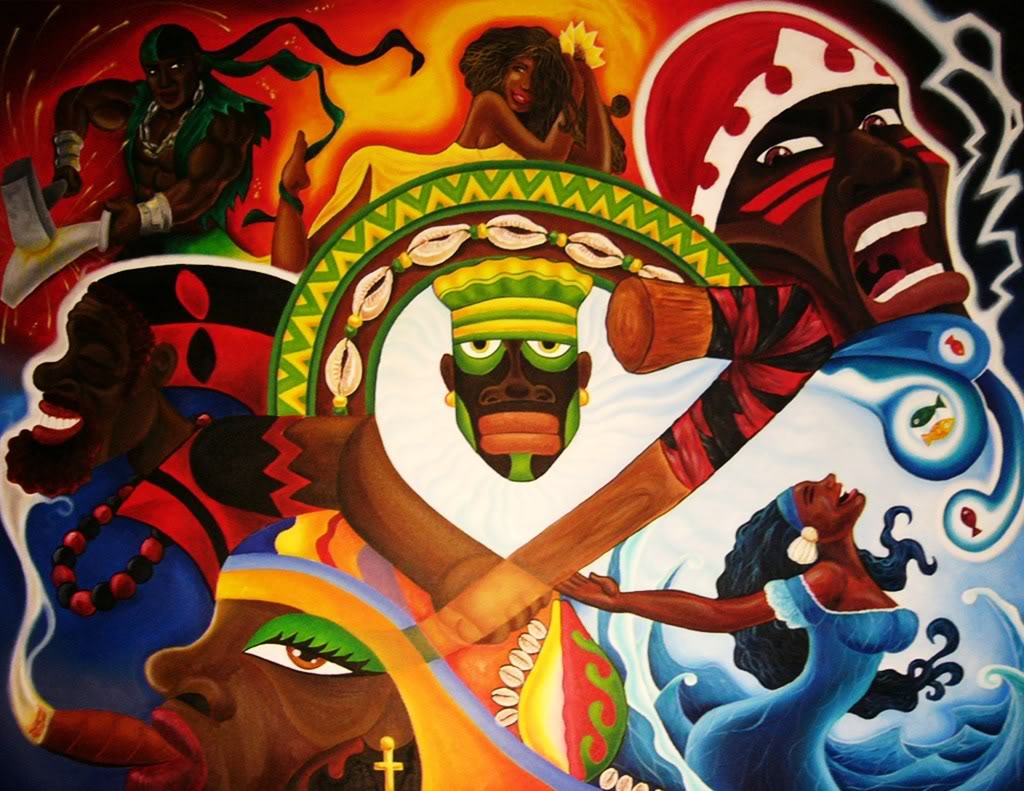
Some of the main Orishas (saints) of Cuban Santería
Elegguà
Orisha protector of travellers, he is the one who opens and closes the roads and crossroads, who, when he dances, resembles a mischievous child. He holds the keys of destiny; he opens and closes the door to misfortune or to happiness. He is the crossroads from which the roads of life branch out. He is the messenger of Olofin and first in everything. He must be greeted before all the other Orishas, he is the first to receive the offerings (but also the last, before the farewell), even the drums begin for him, and his opinion must be asked before every divination, because he protects the paths of consultations and responses. Catholicised with Saint Anthony of Padua, with the Spanish Niño de Atocha, but also with the Anima Sola. His day is Monday, but many also celebrate him on the third day of each month. His colours are red and black. He is a major Orisha. He is the first of the group of the four warriors (Elegguà, Oggùn, Ochosi and Osun). He inspires great fear because he has control over many things and often acts on a whim. He can be merciless if you cross his path when he is angry. He is also a jester and prankster; he can become as irreverent as a little rascal, and he is unpredictable, just like destiny. He is the keeper of Ashé, that is, of spiritual power. He is also a symbol of opposites. This Orisha, in the divination rites, speaks and is represented through the numbers 3 and 21.
Oggùn
Oggùn is an Orisha feared for his unsociable character and for the power of his weapons. He is nothing less than the archetype of the violent manifestations inherent in human nature. His name means war, destruction, but also medicine, good and evil spirit. He is born from the bowels of the earth and his mission is to wage war forever for all men, in religion and in life, because he committed the grave transgression of abusing his mother Yemma when Yemayà taught him the art of love. Obatalà (his father) did not have time to curse him, because it was Oggun who condemned himself, casting upon himself an anathema that would prevent him from sleeping, by day and by night, for as long as the world remained the world. He gets drunk on aguardiente, to forget. According to an ancient Patakì (legend), he was seduced and then abandoned by the alluring Oshùn, who used her charms for the sole purpose of bringing him back to men, from whom he had withdrawn out of disgust. He is charged with providing sustenance to all the Orishas. He has many dealings with the Eggun, the spirits, and he enjoys sorcery. Brother of Changò, violent and cunning, he is the god of minerals, of mountains and of iron in general. Officially married to Oya, he lost his wife, who became the faithful lover of Changò, with whom he is in perpetual conflict. On earth he lives with Ochosi, beside the door of the house so that nothing evil can enter. He has numerous caminos: from the strong and barbaric warrior to the sedentary peasant. Closer to human nature than to divine nature, this Orisha shares in all earthly anxieties and flaws, and is a symbol of everyday life. He rules the keys, the chains, the prison and metal in general, from the machete to the cannons. On his shoulder he carries a tiger-striped bag adorned with many shells. He dresses in green and around his waist wears a little skirt of palm fibres that protect from the ills of life. His necklace is of alternating green and black beads. His dance is very warlike, with a machete in hand, but it also represents work, of an agricultural kind or with anvil and hammer. He protects from fever, from surgical operations and, in general, from all harm arising from ferrous metals and from accidents involving loss of blood. He is the protector of blacksmiths, mechanics, engineers, physicists-chemists and soldiers. His days are Tuesday, Wednesday and the fourth of each month. He is syncretised with Saint Peter.
Yemayà
Mother of life and of the other gods. Wife or, according to some versions, daughter of Obatalà. Goddess of salt water and thus of the sea as the primordial source of life. Protector of women giving birth, of fishermen and sailors. Her anger is terrible, but she always acts with justice. She loves good company; she is a good mother, cheerful and full-blooded. Her day is Saturday. When a woman is pregnant, she performs the rogación and prays to her, so that the child may be born well. In Yemayà love was born; it is no coincidence that she taught it to all the Orishas. She was the wife of Babalù Ayé, of Agallù, of Orula and of Oggùn. Those consecrated to her cannot pronounce her name before having touched the earth with their fingertips and kissed on them the imprint of the dust. There is a special little bell to greet her and to attract her attention. She wears seven silver bracelets and seven skirts as if to represent the seven deep and mysterious seas. Her necklace is made of blue crystals, and she wears a long robe of the same colour with blue and white serpentine patterns. In the dance she announces herself with a resounding laugh and then spins like the waves or the whirlpools of the ocean. Sometimes she rows, while at other times she seems to swim, but she always begins very slowly and increases the intensity of the rhythm like threatening waves. Along with Changò and Ochun, she is among the favourites of the Cubans. She corresponds to the Virgin Mary (Nuestra Señora de la Regla, patron of the Bay of Havana).
Ochùn or Oshùn
Goddess of love, beauty, femininity and rivers. The female counterpart of Changò (of whom she is the lover). Protected by Elegguà and Yemayà, friend of Elegguà who protects her. She always accompanies Yemayà. She lives in the river and assists pregnant women and those giving birth. She is depicted as a beautiful mulatta, likeable, a good dancer and always cheerful. She is capable of resolving, as much as of provoking, quarrels among the Orishas and among men. Her colour is yellow, but she is also attributed sea green and coral tones. She possesses healing virtues that she puts into practice through her waters and honey, of which she is the mistress. Her favourite flower is the sunflower. Her day is Saturday. Catholicised as the Virgin “de la Caridad del Cobre” (patron of Cuba). The colours of Ochun (whose syncretic representation is the Virgin of Charity of Santiago) are yellow and gold, and her number is 5. To her belong the royal peacocks and other birds with colourful plumage. Ochun is essentially the representation of vanity and narcissism. She adores parties and dances, jewels and adornments of every kind, especially of gold.
Obatalà
First among the Orishas. He is the saint dressed in white who protects the mind, the head. Olofi created the universe but gave Obatalà the task of organising the world and of creating humanity. A pure deity par excellence, he loves peace and is merciful. He is the god of thought and of dreams. He allows no one to undress in his presence or to utter insulting or vulgar words. He is the only Orisha to have both male and female paths. According to his manifestation he can be man or woman, old and wise or young and a warrior. Catholicised as the Virgin “de la Mercedes”.
Babalù Aye
Babalú Ayé: healing god of numerous venereal, skin and leprosy diseases, of cholera, of infirmities in general, etc. For this reason he is therefore associated with Saint Lazarus. His colours are white and blue. In Africa he was the main and most venerated saint; in Havana there is a sanctuary in his honour (Rincón), to which thousands of the sick travel every year on 17 December. He is one of the Orishas most invoked by the faithful in Santería, but also by Cuban Catholics. He is the deity concerned with diseases of the body, epidemics, disabilities. The depiction of Babalù Aye, in fact, is that of a crippled beggar, covered in sores, dressed only in a very poor white robe. But Babalù is also the one who helps those who suffer, the saint from whom everyone asks the grace of healing and help in states of physical malaise, in their own health problems or those of loved ones. His messengers are flies and mosquitoes, because they carry diseases around. In the dance he arrives dragging himself like a sick man, wrapped up in himself and, only at the end – after having simulated a kind of “limpieza” (cleansing) rite.
Ochòsi
He is the third member of the group of Orishas called Guerreros and, together with Elegguà, Oggun and Osun, he is given the arrow of justice, to protect the one who receives this initiation, to open and clear his path. Ochosi is a hunter who, in order to chase his prey, explores unknown and rugged territories. In the hierarchy of the Orishas his role is that of intermediary and interpreter for Obatalà, with whom he is in close relationship. His colours are blue and yellow, his material representation is that of a rooster, and his placement within the house of the initiates is in an elevated place.
Oyá
She is the favourite woman of Changò, the mistress of the cemetery; she is also called Iyánsá, meaning that she is the mother who gave birth to nine children. She is the mistress of the strong wind, such as hurricanes and whirlwinds. She is the orisha whose Catholic counterpart is the Virgen de la Candelaria (the Purification of the Virgin), that is, Saint Teresita de Jesús, and the Virgen del Carmen.
Yewá
She is a superior Orisha. She lives in the cemetery among the tombs, and she is responsible for delivering the corpses of the dead to Oya. These are some of the major deities of Santería. There are then countless minor ones. The Yoruba belief system includes an almighty god (Olódùmarè) and 401 Irúnmölè. Naturally there are no univocal rules on names, attributes and legends (patakkìn of oral tradition catalogued only in the 20th century). The rituals vary according to the liturgical schools (reglas).
The Regla Conga or Palo Monte
This religious expression has its roots in religious cults of Bantu origin, a term with which Western ethnology gathers under a single name the community of the peoples of eastern, central and southern Africa who speak the same language in any of its variants. Also known as Mayombe, this regla was the result of the first transitions of Bantu faiths into Cuban society.
In the Regla Conga, in general, a connection with the forces of nature is characteristic; some elements, such as vegetation, are felt to be animated by spirits, where they take refuge, as also in the depths of the earth. The ancestors are represented in water. The centre of the ceremony in this belief is the Nganga, a vessel in which the soul of a dead person is presumed to reside, submitted to the will of the initiate through a pact that nourishes them both.